Fish eat the donkey hide and Pinocchio returns to his puppet form
The Adventures of PinocchioFish eating the donkey hide reverses Pinocchio’s transformation without restoring him to human form: after a man hauls him from the sea expecting a drowned animal, what wriggles at the end of the rope is once again a living wooden Marionette. The episode makes the change literal and visible, while Pinocchio’s account connects it to The Fairy with Azure Hair’s intervention and turns a grisly near-drowning into another escape.
From a donkey to a Marionette
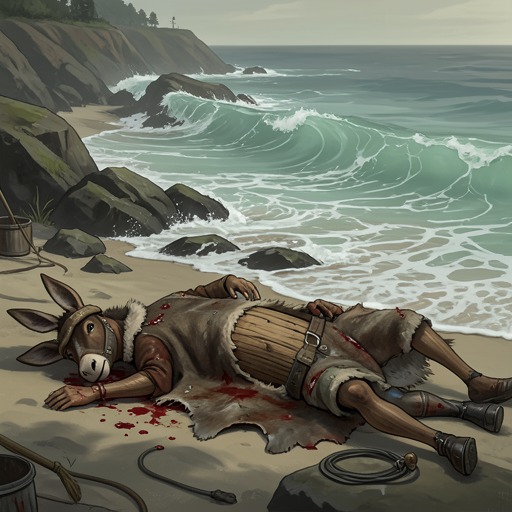
The transformation begins with the man who has bought Pinocchio intending to make a drum from his skin. After tying a rope to Pinocchio’s leg, he throws him into the sea. Fifty minutes pass before the man decides that the lame donkey must be drowned and pulls the rope, expecting to bring up a carcass. Instead, a living puppet appears at the surface, wriggling and squirming. The reversal is immediate: the body the man thought had been submerged as a donkey returns in its earlier wooden form.
Pinocchio’s change is not presented as a human recovery. The fish remove the donkey’s covering but cannot eat through the wood beneath it. Their work undoes the animal appearance while leaving the puppet body intact. The distinction matters to the scene’s comic shock: the man has not retrieved the animal he meant to turn into a drum, but neither has he brought up a boy. Pinocchio is alive, wooden, and still able to speak and act for himself.
Pinocchio explains what happened
Once the man has untied the rope so Pinocchio can tell his story, Pinocchio traces the change back to his own conduct. He recounts that he had been about to become a real boy, but laziness, dislike of books, and the influence of bad companions led him to run away from home; he awoke one morning as a donkey. He was taken to a fair and sold to a Circus Owner, who made him dance and jump through rings. A fall during a performance left him lame, after which the Circus Owner sent him to the marketplace, where the man bought him.
Pinocchio also recounts the immediate cause of his return to puppet form. He tells the man that, after buying him, the man tied a stone to his neck and cast him into the sea, intending to spare him greater suffering. The Fairy, Pinocchio says, saw that he was in danger and sent a thousand fish to where he lay. They mistook him for a dead donkey and ate the hide covering him from head to foot. Pinocchio describes the bites piece by piece: the fish ate his ears, nose, neck, mane, legs, back, and even his tail. When they reached the wood, however, they found it too hard to eat and scattered.
The account makes the fish’s intervention an accidental-looking rescue within Pinocchio’s telling: they approach him as a dead donkey, but their feeding exposes the wooden body that can survive beneath the hide. He credits the Fairy with sending them, and identifies her as his mother, one who continues to watch over him although he believes he does not deserve her care. The rescue thus reveals both the physical mechanism of the reversal and the protective relationship Pinocchio recognizes behind it.
The failed drum and the escape
The man is horrified by Pinocchio’s story, but his astonishment does not make him relinquish his claim. He says he paid four cents for Pinocchio and threatens to take him back to market to sell as dry firewood. Pinocchio accepts the threat in words, then leaps away and dives into the sea. His swift departure prevents the man from turning either the donkey hide into a drum or the wooden puppet into firewood.
As he swims off, Pinocchio calls back that the man can remember him if he needs a drum skin, then repeats the joke in a different form, offering himself as dry firewood. The two taunts answer the man’s attempts to define him by what he can sell or make from his body. Pinocchio grows smaller in the distance until he is only a moving black dot on the water, occasionally lifting a leg or arm; the narrator compares the sight to a porpoise playing in the sun. The image shifts the scene from the man’s control over a tied body to Pinocchio’s energetic movement through the sea.
A threshold between transformations
After swimming for a long time, Pinocchio sees a large white rock in the sea and a little goat standing on it, bleating and beckoning him closer. Its coat is a deep azure, unlike that of other goats, and recalls the hair of The Fairy with Azure Hair. The episode therefore ends not with the fish’s act alone but with Pinocchio moving toward a figure associated by color with the mother who, according to his account, sent the rescuing fish.
The reversal also changes the terms of Pinocchio’s immediate predicament without erasing his earlier history. He is no longer a lame donkey being trained, exhibited, and sold for the value of his hide; he is again a puppet, able to tell his own story, refuse the man’s demand, and swim away. The sea that seemed to be the place of his death becomes the means by which the donkey form is stripped away and he escapes. The return to wood is consequently both rescue and exposure: Pinocchio survives, but the episode does not make him a real boy. It leaves him in motion, approaching the azure-coated goat as the next possibility comes into view.